There is a lesson that both Will and I learned long before we ever stepped into the world of workplace design: what you do when no one is watching matters.
As collegiate athletes, we learned that the moments people see are only a small part of the work. The game is the visible part. The hours of practice, the early mornings, the repetition, the mistakes, the adjustments and the decision to keep getting better are what make the game possible.
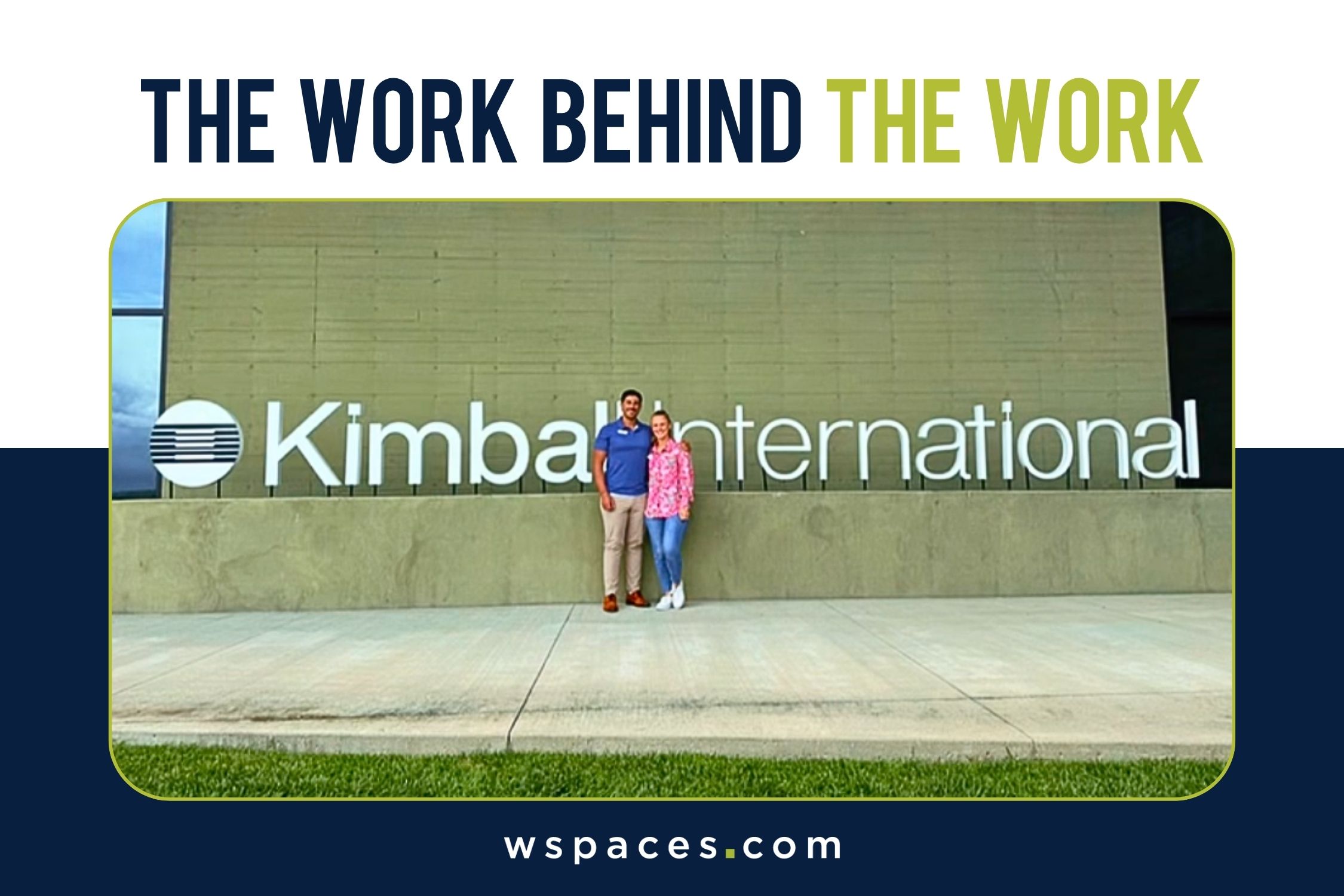
We were reminded of that lesson during our recent trip to Kimball’s headquarters in Jasper, Indiana.
We went to learn more about the products we work with every day. We expected to come home with a deeper understanding of Kimball’s furniture, manufacturing processes and design philosophy. What we didn’t expect was to find so many parallels between what we saw at Kimball and what we believe at Working Spaces.
Because great work has a lot less to do with what people see than with everything that happens before they see it.
Seeing the Work Behind the Product
Walking through Kimball’s headquarters and manufacturing facilities gave us something that a product catalog or showroom simply can’t provide: perspective.
When you sit in a chair in a showroom, you experience the finished product. You can feel the materials, see the finishes and decide whether you like the way it looks. What you don’t see is everything that had to happen before that chair ever reached the showroom.
At Kimball, we got to see some of that work.
We saw the manufacturing process. We saw the testing lab. We saw the thought and attention to detail that goes into the products. We saw how many decisions have to be made to create something that may ultimately look simple to the person using it.
And perhaps most importantly, we saw the people behind all of it.
One of the things that stayed with us was how long so many of the people we met had been with Kimball. Person after person we spoke with had spent 30, 40 or even more years with the company.
We met women who were sewing fabrics together, assembling chairs, measuring materials and carefully matching fabrics so patterns stayed consistent from one piece to the next. These weren’t people who were simply performing a task on an assembly line. They were highly experienced professionals who had spent decades learning their craft.
There was something powerful about that.
Think about what 30 or 40 years of doing something can mean. These people had accumulated an incredible amount of knowledge about the products they were helping create. They understood the details. They knew what to look for. They knew why certain things mattered.
And they were still there, doing the work.
What struck us most was that none of it felt like a performance.
The attention to detail, the craftsmanship and the care we saw weren’t things Kimball suddenly started doing because a group of dealers was visiting. This is the work they do every day.
We just happened to be there to see it.
That distinction mattered to us.
As athletes, we learned quickly that you cannot fake preparation. You can show up on game day and look prepared, but eventually, the work you’ve actually put in will show. The same is true in business.
Excellence isn’t something you turn on when someone is watching. It is built through the things you consistently do when no one is.
A Culture You Can See
One of the things that stood out throughout our visit was how human-centered the Kimball headquarters felt.
That may seem like an obvious observation for a company that designs workplaces, but experiencing it firsthand made us think differently about the relationship between people, culture and space.
A workplace isn’t simply a collection of desks, chairs and conference rooms. The environment where people spend their days communicates something about who they are and how they work.
It can encourage collaboration or create separation. It can make people feel connected or isolated. It can provide spaces for focus, spaces for conversation and spaces where ideas can develop naturally.
The physical environment doesn’t create a company’s culture by itself, but it can absolutely support the culture a company is trying to build.
And that is something we think about every day at Working Spaces.
We believe workplace design should begin with people.
Who are they? How do they work? What does their day actually look like? Where do they need to focus? Where do they need to collaborate? What does their business need the space to accomplish?
Those questions are more important than simply asking how many desks will fit in a room.
Learning From People Who Care
Our experience with Kimball’s team went beyond the manufacturing floor.
One of the biggest reasons we left Jasper feeling more confident in our ability to represent Kimball was the time and energy their team invested in teaching us.
Our trainer, Michele, was a huge part of that.
Michele had a way of taking what could have easily been a long list of product specifications and turning it into something engaging, understandable and memorable. She went into detail. She connected the information to real-world applications. She made us laugh. She asked questions. She encouraged us to think about the products differently.
Most importantly, you could hear the passion in the way she talked about what she does.
That passion translated to us.
By the time we returned to our showroom tours, we felt different. We weren’t simply repeating information we had read in a product guide. We understood more about the products, why certain features mattered and how to think about the application behind them.
That experience reinforced something we believe strongly at Working Spaces: when someone genuinely cares about what they do, that passion is contagious.
It also reminded us that expertise isn’t something you achieve once and then check off a list.
You keep learning.
You keep asking questions.
You keep getting better.
The Right Product Starts With the Right Questions
Our time at Kimball also gave us a deeper appreciation for something that is easy to overlook in our industry: not every product is designed to do the same thing.
There are differences in how products perform, how they are used, how they support people and the environments where they make the most sense.
We don’t need to give away Kimball’s secrets to say that understanding those differences makes us better at what we do.
Our goal isn’t simply to know what products Kimball makes. Our goal is to understand why a particular solution exists, when it makes sense and who it is designed to serve.
That knowledge allows us to have better conversations with our clients.
A conference room chair isn’t necessarily the right chair for someone spending eight hours a day at a workstation. A collaborative space doesn’t have the same requirements as a private office. A training room may need flexibility that an executive environment doesn’t. A client-facing space may have an entirely different set of priorities.
The product should follow the need, not the other way around.
That is why we believe our job is much bigger than selling furniture.
We are here to understand the business behind the space.
Testing What Matters: Including the Client Experience
Another major takeaway from our time at Kimball was seeing just how much investment goes into testing.
Kimball isn’t only testing the products themselves. There is significant thought and investment in understanding how those products perform and how they make their way to the customer.
That includes testing around packaging and delivery as well.
That detail might seem less exciting than sitting in a beautiful new chair or seeing a finished workstation, but to us, it said something important about Kimball’s priorities.
They aren’t only thinking about how a product looks when it leaves their facility. They’re thinking about what happens all the way through the client’s experience.
That resonated with us because we believe the same thing at Working Spaces.
The experience doesn’t begin when furniture arrives at a client’s door, and it certainly doesn’t end when the installation crew leaves.
Every interaction matters.
Every detail matters.
The communication, the recommendation, the product, the delivery, the installation and the follow-through all contribute to how a client experiences working with us.
Seeing how seriously Kimball approaches that entire process challenged us to think about our own processes in the same way.
What We Learned as Athletes Still Applies
One of the strongest connections we made during our visit was between the work we saw at Kimball and something we both experienced as collegiate athletes: preparation creates confidence.
You don’t wait until game day to learn the playbook.
You don’t show up to competition and hope you’ve practiced enough.
You put in the work beforehand so that when the moment comes, you are ready.
We believe the same principle applies to our work at Working Spaces.
Being good at what we do requires consistently working to make ourselves better.
That means learning our products. Understanding workplace trends. Asking better questions. Learning from manufacturers and designers. Building relationships throughout the industry. Paying attention to what our clients are telling us. Staying curious.
Some of that work is visible to our clients.
A lot of it isn’t.
But our clients experience the result of it.
The more we understand, the better questions we can ask. The better questions we ask, the better recommendations we can make. And the better recommendations we make, the more confident our clients can feel about the decisions they are making for their people and their business.
Three Hours That Had Nothing to Do With Furniture
Perhaps one of our favorite parts of the trip had very little to do with furniture at all.
We spent approximately three hours working on public speaking.
Not just talking about products. Not just learning how to give a better presentation. We were asked to stand in front of the group and talk about something we were passionate about.
At first glance, that might seem like a strange addition to a furniture training program. To us, it ended up being one of the most meaningful parts of the entire experience.
It reminded us that being good at this profession requires more than knowing your products. We have to be able to communicate. We have to tell stories. We have to connect with people. We have to be willing to stand in front of a room and talk about something we believe in.
And then Will stood up.
He introduced himself, talked about working at Working Spaces in Kansas City and mentioned that I was his coworker in the St. Louis office.
Then he started talking about his parents.
His father came to the United States from Egypt in 1976. He was homeless and lived in a McDonald’s in California. Decades later, he had owned more than 30 restaurants and nightclubs and eventually retired in Virginia.
His mother came to the United States from Egypt in 1989 knowing only three words of English. She put herself through school, earned a master’s degree in Arabic language, taught herself English along the way and eventually enlisted in the Armed Forces, where she now teaches Arabic to members of the military preparing for special operations.
Will talked about what his parents taught him: that anything is possible and what the American Dream can look like when you are willing to work for it.
When he finished, there was not a dry eye in the room.
What made the moment so powerful wasn’t simply the story itself. It was the depth and authenticity with which he told it.
For those few minutes, Will wasn’t giving a presentation.
He was sharing a piece of himself.
And in doing so, he represented something we think is incredibly important about both Kimball and Working Spaces: people matter. Their stories matter. Their passions matter.
That exercise reminded us that the best relationships aren’t built solely on products or business transactions. They’re built when people are willing to show up as themselves.
Why Our Partnership With Kimball Matters
Our relationship with Kimball as a Preferred Select Dealer is meaningful to us for that reason.
It isn’t simply about having access to a strong product portfolio. It is about having the opportunity to deepen our knowledge and build a relationship with the people behind the products we represent.
There is value in being able to walk through a manufacturing facility and see how something is made. There is value in seeing the testing that happens before a product reaches the market. There is value in being able to learn from people like Michele and the many Kimball employees who have spent decades perfecting their craft.
That knowledge comes back to our clients.
We can take what we learned in Jasper and apply it to the conversations we’re having here in St. Louis and Kansas City and with clients throughout the markets we serve.
Because ultimately, our partnership with Kimball isn’t about us knowing more for the sake of knowing more.
It’s about using that knowledge to serve our clients better.
Bringing Clients Behind the Curtain
One of the most exciting takeaways from the trip was realizing that this is an experience we would love to share with our clients.
There is a difference between telling someone that a product is thoughtfully designed and giving them the opportunity to see the people and process behind it.
Imagine walking through the facility where the products in your workplace are made. Seeing the testing. Understanding the process. Meeting the people who have dedicated decades of their careers to creating better workplace solutions.
It changes the way you look at the finished product.
For the right client and project, having the opportunity to bring them to Kimball’s headquarters would allow us to give them that same perspective.
And that’s the kind of relationship we want to build with our clients.
We don’t want to simply hand someone a product catalog and ask them to pick a chair.
We want to invite them into the process.
We want to understand what they are trying to accomplish, help them understand their options and give them the knowledge they need to make a decision that works for their people and their business.
The Work Behind Working Spaces
We left Kimball with a deeper understanding of furniture, but we came home with something much more valuable: a reminder of why the work behind the work matters.
As athletes, we learned that you don’t become better by showing up only when someone is watching. You become better by consistently putting in the work when no one is keeping score.
We saw that same mindset at Kimball.
We saw it in the people who have spent decades perfecting their craft. We saw it in the testing and attention to detail that happens long before a product reaches a showroom. We saw it in Michele’s passion for teaching us. We saw it in the investment Kimball makes in the entire client experience.
And we felt it in a room full of people when Will shared his story.
All of those moments reinforced something we believe about Working Spaces.
We want to be the team that keeps learning. The team that asks better questions. The team that understands the people sitting in the chairs, not just the chairs themselves. The team that builds relationships before there is a project to sell and continues those relationships long after the furniture is delivered.
We want our clients to know that when they work with us, they aren’t simply getting furniture.
They’re getting a team that cares about understanding their business.
They’re getting people who are willing to do the work behind the scenes so they can make better decisions in front of them.
And they’re getting a partner that believes there is always another question to ask, another thing to learn and another opportunity to get better.
Our visit to Kimball reinforced something we already believe: great spaces don’t happen by accident.
They happen because people care enough to do the work.
And sometimes, the most important work is the work no one ever sees.


